


We use cookies on this site to enhance your user experience. Do You agree?

Read more

Laboratory of Applied Electrochemistry

Description of the group

The group’s scientific interests are mainly related to the development of the next generation of batteries, such as Li-air, Li-O2, Li-CO2, with the emphasis on in-situ/operando techniques. The core of our expertise lies in the synthesis of 1D anodic nanostructures, which we integrate as individual battery components.

Group website: https://damiankowalskide.wixsite.com/group

Research activity

The core of expertise of the Laboratory of Applied Electrochemistry lies in the synthesis of self-organized 1D nanostructures on metals such as titanium, tantalum, niobium, zirconium, and tungsten.

Those electroactive materials display functional properties when applied into electrochemical energy storage devices. We take our inspiration from self-organized systems composed of a few or many components. The focus is on the control of the structures at the nanometer scale by using the tools offered by low- and high-voltage electrochemistry. One of the most recognizable examples is the nanotubular system formed on titanium and iron, leading to the formation of TiO2 and Fe3O4 nanotubes. Beyond fundamental understanding of anodic nanostructures growth, we seek to impart a variety of functions in functional materials, including charge storage ability, de-/lithiation, de-/sodiation, damage detection, and light harvesting.
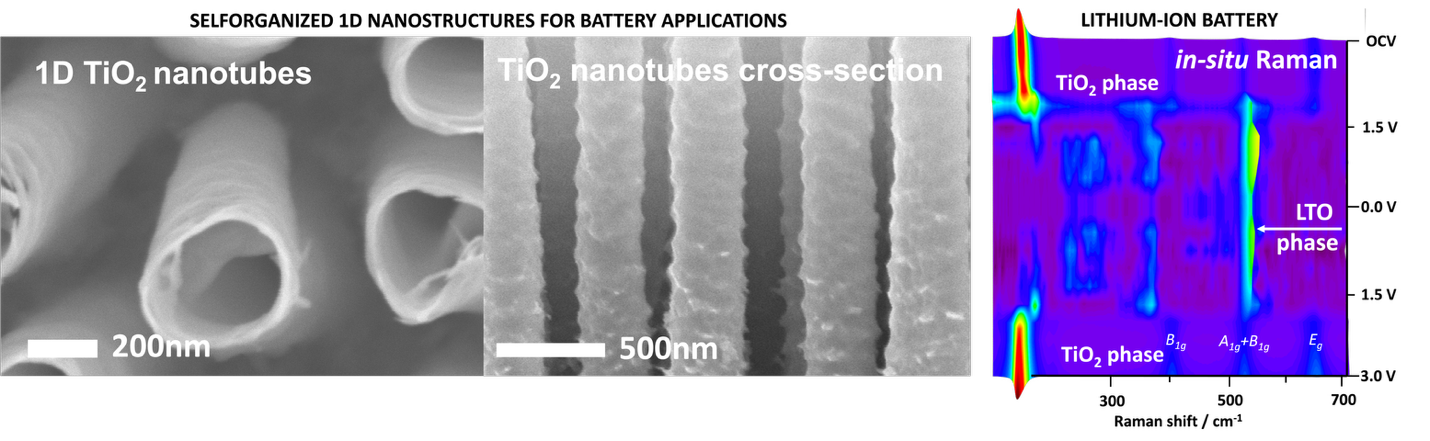
One of the most interesting areas of our research is the implementation of anodic nanostructures in air-batteries such as Li-O2 and Na-O2.

The recent projects are focusing on the development of new concept of integration of CO2 conversion and charge storage in one single device called Li-CO2, Na-CO2 battery.

The electrochemical processes during battery cycling are observed using in-situ/operando techniques for a better fundamental understanding of the battery operation. Our research is highly interdisciplinary, represented from a variety of scientific disciplines including chemistry, engineering and physics. Projects executed at the Laboratory of Applied Electrochemistry:

National projects
• OPUS 28: „Integrated CO2 conversion and energy storage in aprotic Li battery.”
• OPUS 20: „Alkaline air battery.”
• OPUS 11: „Noble-metal and semiconductor core-shell structures for plasmonics, catalysis and photovoltaics.”
• OPUS 6: „1-D polymer solar cell with nanotubular architecture – fundamental understanding of exciton diffusion pathways.”
• PLGRID: „Development of electrocatalysts for alkaline air-batteries (Zn, Fe).”

International projects
• EIG CONCERT JAPAN: „Conversion of atmospheric CO2 into energy storage in Na-CO2 battery.”
• NAWA-MOST Poland-China joint research project: „Development of key technologies for constructing Zn-CO₂ batteries.”

Equipment

 • Glovebox M-Braun Labstar, 4-gloves workstation, equipped with an automatic atmosphere purification and regeneration system for conducting chemical and electrochemical reactions with moisture-sensitive and air-sensitive chemicals. The achievable purity of the working atmosphere inside the chamber is < 1 ppm for O2 and H2O in a dynamic, closed system. |  Room no. 4.102,

• in-situ Raman spectroscopy Thermo Scientific DXR3 equipped with DXR excitation laser wavelength of 532 nm. The unit is equipped with automated stage movement for Raman mapping. The DXR3 provides a full spectral range of 3500 to 50 cm-1 captured with a single exposure of the CCD. It offers a user-adjustable measurement area from 10 μm to 5 mm using Variable Dynamic Point Sampling (VDPS). DXR3 is coupled with a Biologic SP-50 potentiostat/galvanostat and a cell for in-situ/operando measurements of electrochemical reactions occurring at electrodes, e.g., lithium-ion batteries or oxygen batteries (air batteries). Can be operated in oxygen (Li-O2 batteries), carbon dioxide (Li-CO2), and argon atmospheres. | Room no. 4.102,

• Battery cycling workstation Li-O2, 5V100mA, 8 channels. | Room no. 4.101a,

• Battery cycling workstation Li-CO2, 5V50mA, 8 channels. |Room no. 4.102,

• Battery cycling workstation lithium-ion, 5V100mA 8 channels  | Room no. 4.101a,

• Anodization workstation, 60V and 200V with Peltier module temperature control |Room no. 4.102.,

• Photochemical and photobattery workstation located in the darkroom, coupled with Biologic SP-300 potentiostat/galvanostat equipped with Electrochemical Impedance Spectroscopy unit (EIS). | Room no. 4.101a.

Offer

in-situ/operando Raman spectroscopy in the argon, oxygen or carbon dioxide atmosphere,

• battery cycling tests for metal-gas batteries such as Na-O2, Li-O2 oraz Na-CO2, Li-CO2, Zn-air, 28 channels are avilable,

• development of 1D nanostructures by means of anodization process in organic and aqueous electrolytes,
 
• synthesis and analysis of chemicals/materials sensitive to moisture and oxygen in the inert gas atmosphere (argon) < 1 ppm for O2 and H2O,

• Raman spectroscopy analysis with excitation line 532 nm, Raman mapping analysis,

• Electrochemical measurements in the inert gas atmosphere.

Team leader

The group leader completed his doctoral studies at Hokkaido University in Japan in 2007 under the supervision of Prof. Toshiaki Ohtsuka.

From 2007 to 2009, he was a Global Center of Excellence fellow at the Laboratory of Interfacial Electrochemistry at Hokkaido University in the group of Prof. Hiroki Habazaki.

From 2009 to 2014, he was Marie Skłodowska-Curie fellow at the University of Erlangen-Nuremberg in Germany in the group of Prof. Patrik Schmuki. From 2014 to 2016, he worked at the Faculty of Physics at the University of Reims Champagne-Ardenne in France. He is currently affiliated with the University of Warsaw. Dr Kowalski was a participant in the NEDO program, supporting research at the SPRING8 synchrotron radiation facility in Hyogo, Japan (New Energy and Industrial Technology Development Organization).

In addition to international projects, he has led projects funded by the National Science Center: OPUS 6, OPUS 11, OPUS 20, and OPUS 28. He is the coordinator of the international CONCERT JAPAN project, co-author of 60 scientific publications, and three Japanese patents.